
How to Choose the Right Assisted Living Community: 12-Step Checklist [2025 Guide]
The lobby was gorgeous—marble floors, fresh flowers, a grand piano in the corner. It was our first stop on the journey of learning how to choose an assisted living community for my father, and we were instantly impressed. The sales director was charming and attentive, and we were ready to sign the contract that day.

Thank God we didn’t.
On a whim, we decided to return two days later, unannounced, around dinnertime. The grand piano was silent. The flowers were slightly wilted. But that wasn’t what struck us. It was the sound—or lack thereof. The dining room was half-empty, with residents eating in silence. A blinking call light outside one room went unanswered for the ten minutes we stood in the hall. The warm, vibrant community we had been sold felt like a sterile, understaffed waiting room. We realized we had almost chosen a community based on its marketing, not its care.
If you’re facing this monumental decision, you know the stakes are incredibly high. You’re not just choosing an apartment; you’re choosing a new life for your parent. Choosing the wrong community can lead to poor care, unhappiness, and the trauma of another move. But choosing the right one can lead to safety, a renewed social life, and invaluable peace of mind for your entire family.
This guide gives you a 12-step checklist to evaluate assisted living communities objectively. You’ll learn what to look for, what questions to ask, which red flags to never ignore, and how to see past the sales pitch to assess the actual quality of care. By the end, you’ll know exactly how to choose an assisted living community where your parent will be safe, cared for, and—hopefully—happy.
Why Choosing the Right Community Matters
Not all assisted living communities are created equal. The quality of care, staffing, and overall environment can vary dramatically from one facility to the next. Once your parent moves in, the emotional, physical, and financial cost of moving them again is immense. Getting it right the first time is critical.
What the “right” community looks like:
✅ A safe, clean, and well-staffed environment.
✅ Residents who are engaged, social, and appear happy.
✅ Staff who are responsive, attentive, and genuinely caring.
✅ Good quality food and a variety of engaging activities.
✅ Transparent communication with families.
What the “wrong” community looks like:
❌ Understaffing that leads to long waits for help.
❌ Residents who are isolated, bored, and sitting alone in their rooms.
❌ High staff turnover and inconsistent care.
❌ Poor food quality that can lead to malnutrition.
❌ Hidden fees and constant, unexpected price hikes.
So, how do you tell the difference? You use a systematic approach. You use this checklist.
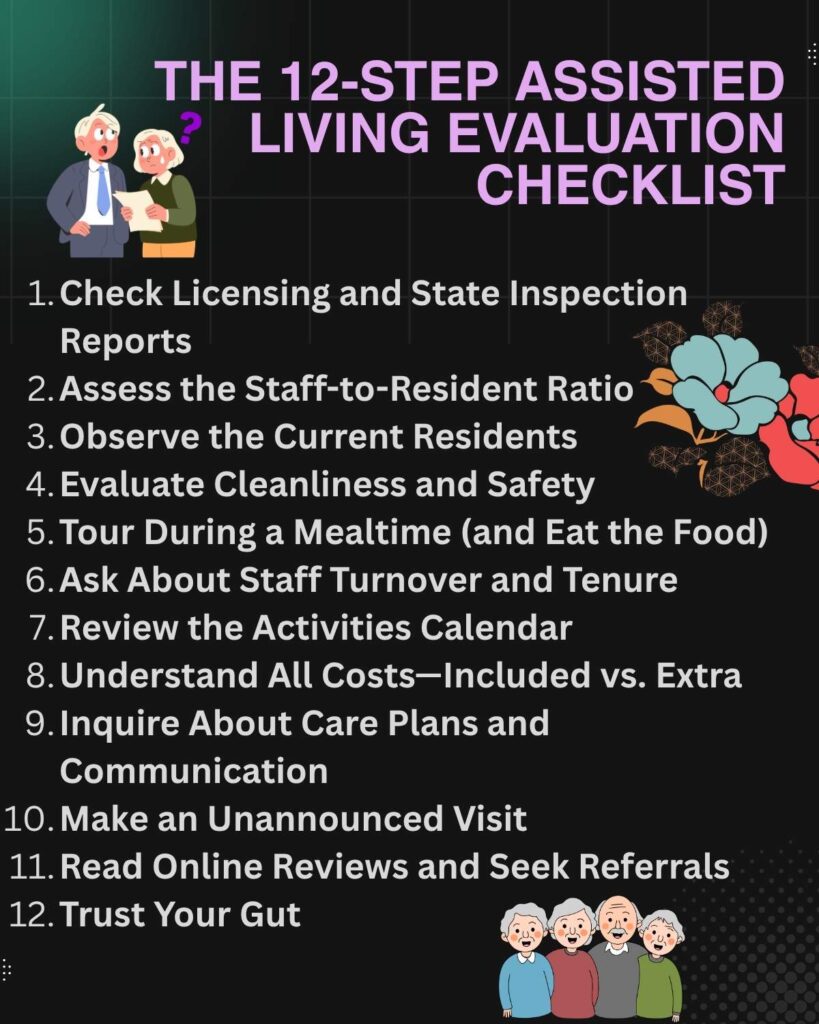
The 12-Step Assisted Living Evaluation Checklist
For the best results, tour at least three different communities. Bring a notebook or print this guide and score each community on every step. The one that scores highest across all 12 areas is likely your best choice.
STEP 1: Check Licensing and State Inspection Reports
Before you even schedule a tour, do your homework online. This is the official, unbiased record of a community’s performance.
- What to do: Ask the community to see their current state license, which should be displayed publicly. More importantly, search online for “[Community Name] + state inspection report” or visit your state’s Department of Health website. These reports detail any violations, from understaffing to safety hazards.
- Why it matters: A fancy lobby can’t hide a history of state violations. This is your first and best look at the real issues behind the scenes.
- Questions to ask:
- “Can I see your most recent state inspection report?”
- “Have you had any serious citations in the past two years?”
- 🚩 Red Flags: The community is defensive or refuses to share their reports; they have recent, serious violations related to neglect, abuse, or safety; they have a long history of repeated violations.
- ✅ Green Flags: Their license is prominently displayed; they willingly provide inspection reports; they have a clean record or can show that any minor violations were corrected immediately.
STEP 2: Assess the Staff-to-Resident Ratio
This may be the single most important indicator of care quality. An understaffed facility cannot provide good care, no matter how nice the building is.
- What to do: Ask for specific numbers. Don’t accept vague answers. Observe the staff during your tour—do they seem rushed and stressed, or calm and attentive?
- Why it matters: Low staffing directly translates to long waits for help with toileting, bathing, or in an emergency. It leads to staff burnout and high turnover.
- Questions to ask:
- “What is your staff-to-resident ratio during the day? And what is it for the overnight shift and on weekends?”
- “How many care staff are on duty for the 50 residents on this floor?”
- 🚩 Red Flags: Vague answers like “We staff based on need” or “We always have enough staff”; ratios worse than 1 staff member to 15 residents during the day; staff seem frantic and unable to make eye contact.
- ✅ Green Flags: They provide specific, confident numbers (e.g., “1 to 8 during the day, 1 to 15 at night”); staff appear calm and have time to interact warmly with residents.
STEP 3: Observe the Current Residents
The people living there now are a living testament to the quality of care. They are a preview of your parent’s potential future.
- What to do: Pay close attention to the residents as you tour. Are they clean and well-groomed? Are they socializing in common areas, or are they sitting alone in their rooms or staring blankly at a TV?
- Why it matters: Happy, engaged residents are a sign of a vibrant community with good care and activities. Isolated, unkempt residents are a major warning sign of neglect.
- What to observe: Look for residents who are dressed appropriately for the time of day (not in pajamas at 2 PM), who are clean with combed hair, and who are interacting with each other or with staff. A good community feels alive.
- 🚩 Red Flags: Most residents are isolated in their rooms; common areas are empty; residents look bored, sad, or disheveled; you don’t see any smiles or hear any laughter.
- ✅ Green Flags: Common areas are active with people talking, playing games, or participating in activities; residents look clean and content; staff greet residents by name and engage in friendly conversation.
STEP 4: Evaluate Cleanliness and Safety
Use all your senses. Your first impression of a facility’s smell and appearance tells you a lot about its management and attention to detail.
- What to do: As you walk through, take a deep breath. Does it smell clean and neutral, or can you detect the odor of urine, feces, or heavy, cloying air fresheners used to mask odors? Look at the floors, corners, and common bathrooms.
- Why it matters: A pervasive smell of urine is a sign that incontinence care is slow and that cleaning protocols are poor. Obvious safety hazards show a disregard for resident well-being.
- What to look for: Look for clean floors, tidy common areas, and spotless bathrooms. Check for safety features like grab bars in all bathrooms, handrails in hallways, good lighting, and emergency call buttons in both the bedroom and bathroom.
- 🚩 Red Flags: A strong smell of urine or heavy air freshener; dirty floors or bathrooms; clutter in hallways; burned-out lightbulbs; broken equipment left sitting out.
- ✅ Green Flags: The facility smells fresh and clean; floors are well-maintained; hallways are wide and clear; safety features are present and in good working order.
STEP 5: Tour During a Mealtime (and Eat the Food)
You would never buy a car without test-driving it. Don’t choose a home for your parent without “test-driving” the food.
- What to do: Schedule at least one of your tours during lunch or dinner. Ask if you and your parent can have a meal in the dining room. Observe everything: the food itself, the atmosphere, and the staff’s interaction with residents.
- Why it matters: Food is a huge component of daily quality of life. Poor food leads to unhappy residents and potential malnutrition. Mealtime is also a key social event.
- Questions to ask:
- “Could I see this week’s menu?”
- “How do you handle special dietary needs, like low-sodium or pureed diets?”
- 🚩 Red Flags: The food looks bland, processed, or unappetizing; there are no choices available; residents are rushed through their meal; staff are not available to help those who need assistance cutting food.
- ✅ Green Flags: The food looks and smells delicious; the menu offers several appealing choices; the dining room is a pleasant, social environment; staff are patient and helpful with residents who need support.
STEP 6: Ask About Staff Turnover and Tenure
A community with a revolving door of staff is a community in trouble.
- What to do: Directly ask the director about their staff turnover rate and the average tenure of their care staff and management.
- Why it matters: High turnover is a symptom of poor management, low pay, and burnout. It results in inconsistent care because new staff don’t know the residents’ individual needs and preferences. A stable staff is a sign of a well-run, positive work environment.
- Questions to ask:
- “What is your annual staff turnover rate?”
- “How long has your Director of Nursing (or wellness) been here?”
- 🚩 Red Flags: They avoid the question or give a vague answer; the director or key managers have been there less than a year; they admit to a high turnover rate (over 50% is a major concern).
- ✅ Green Flags: They can proudly state that many staff members have been there for several years; the management team is long-tenured; the turnover rate is low (under 30% annually).
STEP 7: Review the Activities Calendar
Activities are not just “fun and games”; they are essential for cognitive, physical, and emotional health.
- What to do: Ask to see last month’s activities calendar, not just the plan for the upcoming month. A plan is not reality. Ask what percentage of residents typically participate. During your tour, look to see if an activity is actually happening.
- Why it matters: A full calendar is meaningless if no one participates or if the activities are constantly canceled. Social engagement prevents depression and cognitive decline.
- What to look for: A good calendar has a variety of daily options, including physical (exercise class), social (happy hour), cognitive (trivia), and creative (art class) activities. It should also include regular off-site outings.
- 🚩 Red Flags: The calendar is sparse, with only one or two things per day; the main activity is always Bingo or watching TV; they can’t show you proof (like photos or newsletters) of past events.
- ✅ Green Flags: A packed and varied calendar; you can see an activity in progress with good participation; they offer outings to local shops, restaurants, or parks.
STEP 8: Understand All Costs—Included vs. Extra
The advertised “base rate” is rarely the final price. Understanding the full potential cost is crucial to avoid devastating financial surprises.
- What to do: Ask for a detailed, written fee schedule that clearly separates what is included in the base rent from what services are “a la carte” and cost extra.
- Why it matters: “Hidden fees” are one of the biggest complaints families have. Add-on costs for things like medication management or a higher level of care can increase the monthly bill by 30-50%.
- Questions to ask:
- “What are your different levels of care, and what is the specific monthly cost for each?”
- “What are the most common services that cost extra?”
- “Historically, how much has your community raised its rates each year?”
- 🚩 Red Flags: They are vague about costs or unwilling to provide a written fee schedule; the pricing structure is confusing; they have a history of large, unpredictable rate hikes.
- ✅ Green Flags: They provide a clear, easy-to-understand document detailing all potential costs; they are transparent about their rate increase history (typically 3-5% annually is standard).
STEP 9: Inquire About Care Plans and Communication
A good community doesn’t use a one-size-fits-all approach. They create a personalized plan for each resident.
- What to do: Ask about their process for assessing a new resident’s needs and creating an initial care plan. Inquire about how often that plan is updated and how they communicate changes to the family.
- Why it matters: An individualized care plan ensures your parent gets the specific support they need. Regular updates mean the community is responsive to changes in their health. Proactive communication keeps you in the loop.
- Questions to ask:
- “Can you walk me through your care planning process?”
- “How often do you meet with families to review the care plan?”
- “If my mother has a fall or a health change, what is your protocol for notifying me?”
- 🚩 Red Flags: No formal assessment or care planning process; they rarely update plans; they only contact families in major emergencies.
- ✅ Green Flags: They conduct a comprehensive assessment with a nurse before move-in; care plans are reviewed quarterly or with any change in condition; they designate a specific point of contact for family communication.
STEP 10: Make an Unannounced Visit
This is the single most important step in this entire checklist.
- What to do: After your initial scheduled tour, return a few days later without an appointment. Try a different time of day, like an evening or a weekend.
- Why it matters: Any community can look good when they’re expecting you. An unannounced visit shows you what daily life is really like when the “sales mode” is off.
- What to observe: Is the atmosphere the same? Are staffing levels as high as they claimed? Are residents still engaged and well-cared-for? How long does it take for someone to greet you? If the quality you see on a Saturday evening matches the quality you saw on a Tuesday morning, that’s an excellent sign.
- 🚩 Red Flags: The facility is noticeably dirtier or less staffed; residents are all in their rooms; the atmosphere feels chaotic or depressing; it’s a completely different place than the one you toured.
- ✅ Green Flags: The environment, staffing, and resident mood are consistent with your first visit. The quality holds up under scrutiny.
STEP 11: Read Online Reviews and Seek Referrals
Let the experiences of other families guide you.
- What to do: Go to Google, Caring.com, and A Place for Mom and search for reviews of the communities on your short list. Read at least 15-20 reviews for each, looking for consistent patterns.
- Why it matters: While any community can have one or two disgruntled families, a pattern of consistent complaints about the same issue (understaffing, poor food, hidden fees) is a huge red flag.
- What to look for: Look for an overall rating of 4.0 stars or higher. Pay attention to reviews that praise specific staff members by name or highlight the quality of care. Note how management responds to negative reviews—professionally or defensively?
- 🚩 Red Flags: An overall rating below 3.5 stars; multiple recent reviews complaining about the same problems; management getting into arguments with reviewers online.
- ✅ Green Flags: A high overall rating; consistent praise for staff and care; professional, solution-oriented responses to any negative feedback.
STEP 12: Trust Your Gut
After you’ve gathered all the data, take a moment to listen to your intuition.
- What to do: Ask yourself, “After everything I’ve seen and heard, can I picture my mom or dad living here? Would I feel safe and cared for here?”
- Why it matters: Sometimes, your gut feeling picks up on subtle cues that a checklist can’t capture. You know your parent’s personality and what kind of environment they would thrive in.
- If something feels “off” about a place, even if you can’t pinpoint why, trust that feeling. If you feel a sense of peace and confidence about a community, that is valuable data. Your intuition is the final and most personal check on your decision.
Comparison Table: Scoring Your Top Communities
Use this table to objectively score the 3 communities you’re seriously considering. Rate each factor from 1-5 (1=Poor, 5=Excellent). The highest total score is your data-driven winner.
| Evaluation Factor | Community A | Community B | Community C |
|---|---|---|---|
| Licensing & Inspection Record | /5 | /5 | /5 |
| Staff-to-Resident Ratio | /5 | /5 | /5 |
| Resident Engagement & Happiness | /5 | /5 | /5 |
| Cleanliness & Safety | /5 | /5 | /5 |
| Food Quality & Dining Experience | /5 | /5 | /5 |
| Staff Stability & Retention | /5 | /5 | /5 |
| Activities Calendar & Participation | /5 | /5 | /5 |
| Transparent Pricing | /5 | /5 | /5 |
| Individualized Care Plans | /5 | /5 | /5 |
| Unannounced Visit Quality | /5 | /5 | /5 |
| Online Reviews & Reputation | /5 | /5 | /5 |
| Your “Gut Feeling” | /5 | /5 | /5 |
| TOTAL SCORE | /60 | /60 | /60 |
Conclusion
Choosing the right assisted living community is one of the most important and overwhelming decisions you’ll make for your parent. The beautiful lobbies and charming sales directors can make every community look appealing, but the reality of care quality can vary dramatically.
That’s why a systematic approach is essential. Use the 12-step checklist in this guide to look past the marketing and evaluate what truly matters: licensing, staffing, resident happiness, cleanliness, food quality, and transparency.
Yes, it takes time—plan for 4-6 weeks to do this properly. But rushing this decision can lead to regret, unsafe care, and the trauma of moving your parent a second time. Take the time to tour multiple communities. Eat their food. Visit unannounced. Ask hard questions. And trust your gut. The community that welcomes your scrutiny, shows you transparency, and has genuinely happy residents is the one that has earned your trust. You’re not looking for a perfect place, but a safe, caring, and dignified one. This is hard, but by doing your homework, you are doing the right thing. You’ve got this. 💙
Continue Your Research:
- How to Talk to Your Parent About Moving to Assisted Living → – Navigate this difficult conversation with compassion.
- How to Pay for Assisted Living: Complete Financial Guide → – Explore all payment options and aid programs.
- Assisted Living vs. Memory Care: What’s the Difference? → – Understand when dementia requires specialized care.
- 15 Warning Signs Your Parent Can’t Live Alone Safely → – Assess whether your parent needs care now.